


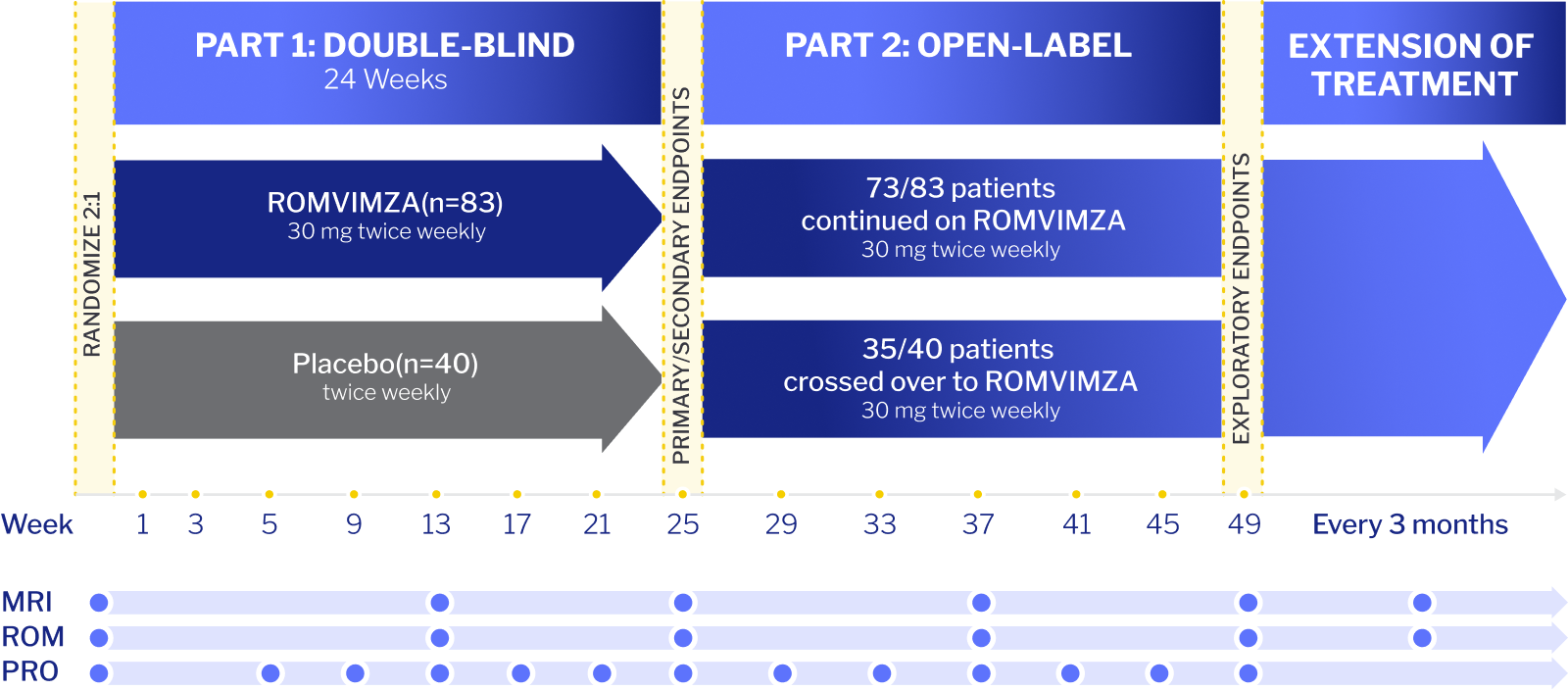
ROMVIMZA was studied inMOTION: A global multicenter, randomized, double‑blind, placebo‑controlled, phase 3 study in 123 patients with symptomatic TGCT1,2

Key eligibility criteria3
 Patients 18 years or older
- Confirmed diagnosis of symptomatic TGCT for which surgical resection would potentially cause worsening functional limitation or severe morbidity
Key exclusion criteria3
- Previous use of systemic therapy (investigational or approved) targeting CSF1 or CSF1R
 Previous treatment with imatinib or nilotinib was allowed
Tumor response at Week 25 (6 months)1
Primary endpoint:
- ORR by RECIST v1.1 (tumor length) per IRR
Key secondary endpoint:
- ORR by TVS (tumor volume) per IRR
Symptomatic and Functional Outcomes at Week 25 (6 months)1
Additional key secondary endpoints:
 ROM:change from baseline in active ROM
 Physical function:change from baseline
in PROMIS‑PF Pain:patient-reported BPI-30 worst pain response rate
BPI=Brief Pain Inventory; CSF1=colony‑stimulating factor 1; CSF1R=colony‑stimulating factor 1 receptor; IRR=independent radiologic review; ORR=objective response rate; PROMIS‑PF=Patient‑Reported Outcomes Measurement Information System Physical Function (TGCT‑specific); RECIST v1.1=Response Evaluation Criteria in Solid Tumors version 1.1; ROM=range of motion; TGCT=tenosynovial giant cell tumor; TVS=tumor volume score.
The MOTION study included a patient population reflective of real‑world clinical experience—with the majority of study sites in Europe and North America1,2
| ROMVIMZA n=83 | Placebo n=40 | |
|---|---|---|
| Median (IQR) age, years | 45 (33-53) | 43 (31-53) |
| Sex | ||
| Female | 46 (55%) | 27 (68%) |
| Male | 37 (45%) | 13 (33%) |
| Region | ||
| Europe | 57 (69%) | 32 (80%) |
| USA and Canada | 14 (17%) | 5 (13%) |
| Australia | 12 (14%) | 2 (5%) |
| Asia | 0 | 1 (3%) |
| Affected Joint | ||
| Knee | 56 (67%) | 27 (68%) |
| Ankle | 9 (11%) | 6 (15%) |
| Hip | 11 (13%) | 1 (3%) |
| Other* | 7 (8%) | 6 (15%) |
| Prior TGCT surgery or procedure† | 64 (77%) | 27 (68%) |
| 0 surgeries | 19 (23%) | 13 (33%) |
| 1 surgery | 28 (34%) | 14 (35%) |
| 2-3 surgeries | 26 (31%) | 11 (28%) |
| ≥4 surgeries | 10 (12%) | 2 (5%) |
| Prior TGCT systemic therapy | 19 (23%) | 9 (23%)‡ |
| Imatinib | 16 (19%) | 7 (18%) |
| Nilotinib | 2 (2%) | 4 (10%) |
| Other§ | 1 (1%) | 0 |
*Includes foot, wrist, hand, shoulder, elbow, and temporomandibular joint.
†All patients had histologically confirmed TGCT per diagnostic biopsy or existing pathology report; diagnostic biopsies were not recorded as a prior surgery or procedure.
‡Two patients in the placebo arm received both imatinib and nilotinib.
§Includes an investigational agent (BP 27 672).
IQR=interquartile range; USA=United States of America.

Inform your patients they may be able to help advance TGCT research by taking part in a phase 4 study sponsored by Deciphera
Learn more


